
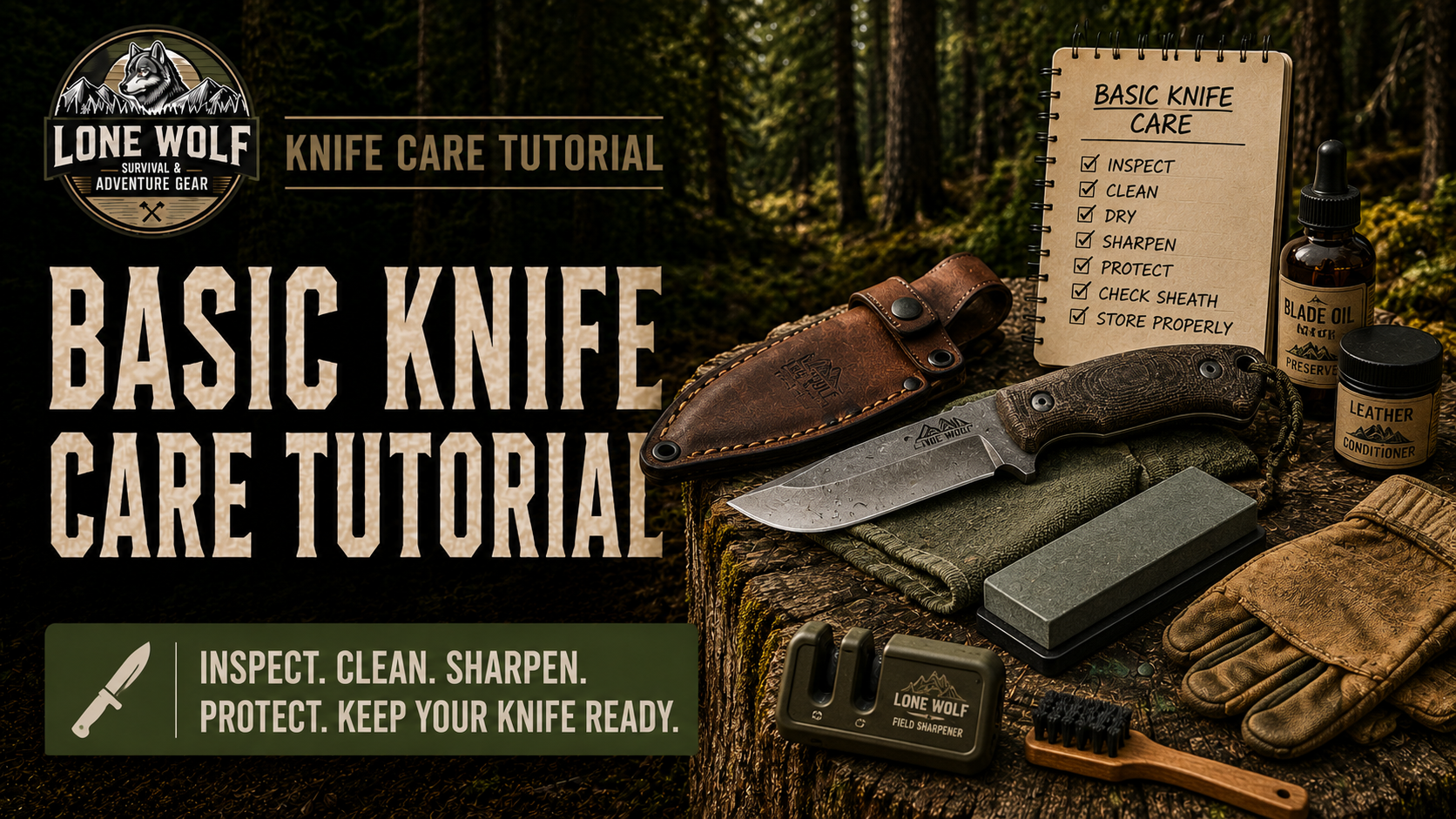
Basic Knife Care Tutorial
How to Clean, Protect, and Maintain Your Survival Knife
You Are Here
Introduction
A survival knife is exposed to moisture, dirt, sap, blood, food residue, salt, abrasion, and other conditions that can affect its edge, blade, handle, hardware, and sheath. Regular care keeps those everyday exposures from developing into corrosion, edge damage, looseness, sheath problems, or other issues that interfere with the knife’s performance.
Basic knife care centers on a few repeatable practices: clean the knife after use, dry it completely, protect exposed steel when needed, maintain the cutting edge, inspect the knife and sheath, and store everything properly. These habits help preserve cutting performance, extend the useful life of the knife, and make developing problems easier to catch and correct.
This tutorial covers the basic care practices every survival knife owner should understand. It also provides maintenance checklists, common problems and quick fixes, practical decision scenarios, and a short quiz to reinforce the key points.
Start Here
The Basic Knife Care Tutorial is the foundational beginner article in the Survival Knife Care and Maintenance Hub. It covers the routine care needed to keep a survival knife clean, protected, sharp, inspected, and properly stored.
The article is organized into seven main care areas:
- Safety and handling
- Edge and steel basics
- Cleaning after use
- Rust prevention and oiling
- Edge maintenance and sharpening
- Storage and sheath care
- Inspection, checklists, and common problems
If you are new to knife care, start with Safety & Handling Basics and work through the article in order. If you are looking for a specific maintenance task, use the Jump To section to go directly to it.
After you are comfortable with these basic care practices, continue through the Survival Knife Care and Maintenance Hub for more detailed sharpening, inspection, repair, and long-term maintenance.
Jump To
- Introduction
- Start Here
- Safety & Handling Basics
- Edge & Steel Basics
- Cleaning Your Knife After Use
- Rust Prevention & Oiling
- Simple Edge Maintenance & When to Sharpen
- Storage, Sheaths & Long-Term Care
- Maintenance Checklists
- Common Mistakes & Quick Fixes
- Decision Scenario: Wet Carbon Steel Knife After a Day Outside
- Decision Scenario: The Knife Still Cuts, but Performance Is Reduced
- Decision Scenario: A Dirty Knife After Mixed Use
- Knife Care FAQ
- Knife Care Quick Quiz
- Conclusion
- Explore More Survival Knife Guides
Safety & Handling Basics
Knife care often puts your hands close to the cutting edge while the knife is wet, oily, dirty, or being sharpened. Safe handling reduces the chance of injury while you clean, inspect, maintain, and store the knife.
- Treat every knife as sharp. Keep your attention on the blade whenever it is unsheathed or unfolded.
- Keep your hands clear of the cutting edge. Position the knife so a slip will move the blade away from your fingers and body.
- Use a stable work surface. Clean, inspect, and sharpen the knife on a solid surface where you can maintain control.
- Maintain a secure grip. Wet, oily, or dirty handles can become slippery, so clean your hands and the handle when necessary.
- Work without distractions. Give maintenance tasks your full attention, especially when cleaning near the edge or sharpening.
- Secure the knife when finished. Return it to its sheath, case, or other safe storage location after maintenance is complete.
A cut that occurs during routine maintenance is avoidable. Controlled handling protects you while you care for the knife and allows you to concentrate on the condition of the blade, edge, handle, hardware, and sheath.
Edge & Steel Basics
The cutting edge and blade steel determine how a knife performs and how it should be maintained. Understanding a few basic terms makes it easier to recognize wear, choose the right maintenance method, and protect the knife from corrosion or unnecessary damage.
Edge Basics
- Edge bevel: The angled surface that forms the cutting edge.
- Edge angle: Many general-use survival knives are commonly sharpened around 18 to 22 degrees per side, although the appropriate angle depends on the knife, steel, edge geometry, intended use, and manufacturer.
- Edge wear: Cutting gradually produces dulling, rolling, chipping, and other small changes along the edge.
- Edge performance: A properly maintained edge should cut efficiently without requiring excessive force.
Steel Basics
Knife steels differ in several important ways:
- Corrosion resistance: How well the steel resists rust and staining.
- Toughness: How well the steel resists chipping, cracking, and breakage.
- Edge retention: How long the cutting edge continues to perform before sharpening is needed.
- Sharpenability: How easily the steel responds to available abrasives and sharpening methods.
Carbon and low-alloy steels generally require closer attention to moisture and corrosion. Many stainless steels provide greater corrosion resistance, but they still require cleaning and drying. High-wear steels may hold an edge longer but often require more effective abrasives when sharpening.
Knowing the steel in your knife helps you choose appropriate corrosion protection, sharpening equipment, and maintenance methods.
Cleaning Your Knife After Use
Cleaning removes moisture, dirt, salt, blood, sap, food residue, and other contaminants that can affect the blade, handle, hardware, and sheath. Cleaning the knife soon after use helps prevent corrosion, staining, buildup, and other avoidable problems.
Basic Cleaning Checklist
- Wipe the blade after wet, dirty, or messy cutting tasks.
- Wash with mild soap and warm water when needed after cutting food, meat, or sticky substances.
- Avoid soaking the knife, especially folding knives and knives with wood or other moisture-sensitive handle materials.
- Use a soft cloth or brush around the guard, handle, hardware, pivot areas, and textured surfaces where residue can collect.
- Rinse away soap and loosened contaminants.
- Dry the blade, handle, hardware, tang area, and other exposed surfaces completely.
Special Cleaning Situations
Blood and Game Processing
Clean the knife as soon as practical. Remove blood and other biological residue before it dries on the blade or handle.
Sap and Resin
Loosen stubborn residue with an appropriate cleaner or a small amount of oil, then wipe the knife clean and dry it.
Saltwater
Rinse the knife with fresh water as soon as practical, dry it completely, and protect exposed steel afterward.
Regular cleaning makes the rest of knife maintenance easier by giving you a clean surface to inspect, protect, and maintain.
Rust Prevention & Oiling
Corrosion protection helps preserve exposed steel after cleaning and drying. The amount of protection a knife needs depends on the steel, environment, use, and storage conditions.
Choosing an Oil or Protectant
- Food-safe protectant: For knives used with food, choose a product appropriate for food-contact surfaces, such as food-grade mineral oil.
- Dedicated corrosion inhibitor: Carbon steels and knives used in wet, humid, salty, or corrosive conditions may benefit from a dedicated knife protectant.
- Multi-use protectants: Some products made for tools or firearms may provide effective corrosion protection. Make sure the product is appropriate for the knife’s materials and intended use.
How to Protect the Blade
- Clean the knife.
- Dry the blade completely.
- Apply a small amount of oil or protectant to a soft cloth or patch.
- Wipe a thin, even film over exposed steel.
- Lubricate folding-knife pivots according to the manufacturer’s guidance when needed.
- Wipe away excess product.
The goal is a thin protective film that reduces exposure to moisture and corrosive contaminants.
Build a Simple Knife Care Kit
A compact knife care kit makes routine maintenance easier at home, in a vehicle, or while traveling.
Useful items include:
- microfiber cloths or shop rags;
- food-safe mineral oil or another appropriate knife protectant;
- a rust eraser or suitable mild abrasive for early surface corrosion;
- a compact strop or strip of leather with appropriate compound;
- a small nylon or brass brush for guards, pivots, hardware, and textured areas.
Keep the kit simple enough that you will actually use it.
Simple Edge Maintenance & When to Sharpen
Edge maintenance keeps a knife cutting efficiently and helps you recognize when light touch-up work is enough and when a full sharpening session is needed.
Check the Edge First
Before sharpening, look at how the knife is actually performing.
- Paper test: Slice clean paper. A properly maintained utility edge should cut without excessive pressure, snagging, or tearing.
- Visual check: Examine the edge under good lighting. Shiny flat spots along the apex can indicate dulling, rolling, or damage.
- Cutting performance: Pay attention to how the knife behaves during normal tasks. If the edge begins sliding instead of biting or requires noticeably more force, it needs attention.
Avoid running your fingers along the cutting edge to test sharpness.
Stropping Between Sharpenings
A strop can restore or refine an edge that has lost some cutting performance without requiring significant metal removal.
- Use light pressure.
- Move the blade edge-trailing, with the spine leading the stroke.
- Maintain a consistent angle.
- Alternate sides as needed.
- Check cutting performance periodically.
If stropping restores useful cutting performance, a full sharpening session may not be necessary.
Away From Home
Basic edge maintenance away from home should focus on keeping the knife serviceable until you have access to a stable work area and your normal sharpening equipment.
- Wipe the blade clean before working on the edge.
- Use a compact strop or field sharpener for minor maintenance.
- Concentrate on restoring useful cutting performance.
- Perform more detailed sharpening later if the edge needs substantial correction.
At Home or After a Trip
- Clean the knife thoroughly.
- Inspect the edge for chips, rolls, flat spots, or other damage.
- Strop the edge if light maintenance is sufficient.
- Sharpen the edge when performance requires more than stropping.
- Check the finished edge before returning the knife to use or storage.
When to Sharpen
A full sharpening session is appropriate when:
- cutting requires noticeably more pressure;
- the edge slides instead of biting;
- stropping no longer restores useful performance;
- chips, rolls, or flat areas affect cutting;
- the edge geometry needs correction.
For detailed sharpening instruction, continue to Knife Sharpening 101 and the more advanced sharpening material in the Survival Knife Care and Maintenance Hub.
Storage, Sheaths & Long-Term Care
Proper storage protects a knife between uses and helps prevent corrosion, sheath damage, edge damage, and other problems that can develop while the knife sits unused. The storage method should keep the knife dry, protected, and easy to inspect.
General Storage Rules
- Dry the knife completely: Remove moisture before putting the knife into storage.
- Protect from humidity and condensation: Store the knife where moisture exposure is limited.
- Protect the cutting edge: Keep the edge from striking or rubbing against other knives, tools, or hard surfaces.
- Inspect stored knives: Check knives periodically for corrosion, looseness, sheath problems, or other developing issues.
Leather Sheaths
Leather works well for carrying many knives, but it can retain moisture against the blade.
For long-term storage, removing the knife from a leather sheath is often the better choice, especially with carbon and low-alloy steels. Make sure both the knife and sheath are completely dry before storage.
Kydex and Synthetic Sheaths
Kydex and other synthetic sheaths absorb less moisture than leather, but dirt, water, salt, and other contaminants can still collect inside them.
Clean the inside of the sheath when needed and allow it to dry completely before returning the knife.
Rolls, Cases & Racks
Knife rolls, padded cases, racks, and other dedicated storage systems help protect blades from impact and keep knives separated and organized.
Choose a storage method that keeps the knife dry, protects the cutting edge, and allows you to inspect the knife easily.
Knives Stored in Vehicles, Packs, Garages & Sheds
Knives stored in vehicles, packs, garages, sheds, and similar locations may be exposed to greater humidity and condensation than knives stored indoors under controlled conditions.
Inspect these knives more often and check both the knife and sheath for trapped moisture, corrosion, and other developing problems.
Maintenance Checklists
Checklists make routine knife care easier to perform consistently. They help you catch small problems early and make sure the knife, sheath, and supporting equipment are ready before use, after use, and during storage.
After-Use Checklist
- Wipe the blade clean.
- Wash the knife when needed after contact with food, blood, sap, salt, or other contaminants.
- Dry the blade, handle, hardware, and sheath completely.
- Apply corrosion protection when appropriate.
- Inspect the edge for chips, rolls, flat spots, or other damage.
- Strop the edge if cutting performance has declined and stropping is appropriate.
- Check the handle, fasteners, guard, and other structural components.
- Store the knife in a dry location.
Pre-Trip Checklist
- Inspect the cutting edge.
- Sharpen or touch up the edge if performance has declined.
- Check the blade for corrosion or damage.
- Inspect the handle, fasteners, guard, pommel, and other structural components as applicable.
- Check sheath condition and retention.
- Make sure the sheath is clean and dry.
- Pack any field-maintenance equipment you expect to need.
Post-Trip / Seasonal Checklist
- Thoroughly clean the knife.
- Remove dirt, blood, sap, salt, food residue, and other contaminants.
- Dry the knife completely.
- Protect exposed steel when needed.
- Inspect the blade, edge, handle, hardware, and sheath.
- Check the sheath for moisture, debris, damage, or mold.
- Address developing problems before returning the knife to storage.
Common Mistakes & Quick Fixes
Most knife-care problems begin as small issues that are easy to correct when they are caught early. Recognizing common mistakes helps prevent corrosion, edge damage, sheath problems, and unnecessary wear.
Leaving a Knife Wet
Moisture left on exposed steel encourages staining and corrosion.
Correction: Clean and dry the knife after exposure to moisture.
Storing a Knife Long-Term in Damp Leather
Leather can hold moisture against the blade.
Correction: Dry both the knife and sheath. For long-term storage, consider storing the knife outside the leather sheath.
Ignoring Corrosion-Prone Steel
Carbon and low-alloy steels may develop corrosion quickly in humid or wet conditions.
Correction: Clean, dry, inspect, and protect the steel according to its corrosion resistance and the conditions in which it is used.
Ignoring Early Rust
Light surface corrosion is usually easier to address than established pitting.
Correction: Remove early corrosion using an appropriate method, clean the surface, and restore corrosion protection.
Using a Knife as a Pry Bar
Prying places loads on the blade and tip that many knives were never designed to withstand.
Correction: Use the appropriate tool for prying tasks.
Quick Fixes
- Light surface rust: Use an appropriate mild abrasive or rust-removal method, then clean and protect the steel.
- Dirty or sticky folding-knife pivot: Clean according to the manufacturer’s instructions and lubricate appropriately.
- Minor edge damage: Evaluate the damage and sharpen with the appropriate stones, abrasives, or guided system.
- Structural damage: Stop using the knife when cracks, major looseness, severe blade damage, handle failure, or another structural problem makes continued use unsafe.
Routine care prevents most avoidable knife problems. Clean, inspect, protect, and maintain the knife as problems develop.
Decision Scenario: Wet Carbon Steel Knife After a Day Outside
You return to your vehicle after spending several hours outside in steady rain. Your carbon steel survival knife is wet and has a light coating of mud and wood residue on the blade. The leather sheath is also damp. Your full knife-care kit is at home, but you have a clean cloth, fresh water, and a small bottle of knife protectant in the vehicle.
What should you do before putting the knife away?
Hidden Training Review
Best Choice
Option B is the best choice.
The immediate priorities are to remove contaminants, eliminate as much moisture as possible, protect the corrosion-prone steel, and avoid putting the knife back into a damp leather sheath.
Option A addresses the blade but returns it to an environment that may hold moisture against the steel.
Option C correctly removes moisture and keeps the knife out of the damp sheath, but it leaves carbon steel unprotected even though an appropriate protectant is available.
Why the Sequence Matters
The order matters:
- Remove dirt and contaminants.
- Dry the knife completely.
- Apply appropriate corrosion protection.
- Keep the knife away from a damp sheath.
- Complete a more thorough inspection and cleaning when better equipment is available.
The goal is not to perform perfect maintenance beside the vehicle. The goal is to control the immediate problems correctly and avoid creating a new one while you wait to finish the job.
Changed Condition
When you get home, you discover that the leather sheath is soaked through rather than merely damp.
What changes?
Do not return the knife to the sheath after completing the full cleaning. Allow the sheath to dry completely and inspect it for retained moisture, debris, damage, or developing mold before using it again.
The knife and sheath should be treated as two separate maintenance items. A clean, dry blade can still develop corrosion if it is placed back into a wet sheath.
Training Takeaway
When moisture, contaminants, and corrosion-prone steel are involved, prioritize cleaning, drying, protection, and separation from wet storage materials.
Decision Scenario: The Knife Still Cuts, but Performance Is Reduced
You have been using your survival knife for several days to cut cordage, cardboard, food packaging, and small pieces of wood. The knife still cuts, but it takes more pressure than it did before, and you notice a few shiny spots along the edge under good light.
You have a strop, a medium sharpening stone, and your normal sharpening setup available.
What should you do first?
Hidden Training Review
Best Choice
Option B is the best choice.
The knife is showing signs of edge wear, but it is still cutting and there is no indication yet that substantial metal removal is necessary.
Stropping is the least aggressive maintenance step and may restore useful cutting performance without changing the edge geometry or removing more steel than needed.
Option A may work, but it moves directly to abrasive sharpening before confirming that sharpening is necessary.
Option C delays maintenance even though the edge is already showing signs of reduced performance.
Why the Sequence Matters
Use the least aggressive maintenance method that solves the problem:
- Inspect the edge.
- Identify the type of wear.
- Strop if the edge appears suitable for light maintenance.
- Test cutting performance again.
- Sharpen only if stropping does not restore useful performance or the edge damage requires abrasive correction.
This approach preserves blade material while keeping the knife working efficiently.
Changed Condition
After stropping, the knife cuts better, but one shiny spot remains. Under closer inspection, you discover a small chip in the edge.
What changes?
The remaining problem is no longer simple edge wear that stropping is likely to correct.
Inspect the chip carefully and determine whether it affects normal cutting performance. If it does, use an appropriate sharpening method to remove or reduce the damaged area while maintaining the intended edge geometry.
A very small chip that does not interfere with normal use may not require immediate heavy sharpening. The goal is to correct the damage without removing more steel than necessary.
Training Takeaway
When an edge begins to lose performance, inspect first, use the least aggressive maintenance method that works, and move to sharpening only when the edge actually requires it.
Decision Scenario: A Dirty Knife After Mixed Use
You have used your survival knife during the day to cut wood that leaves sap or sticky residue on the blade, dirty cordage, and food packaging. Fine grit has collected near the guard and handle, and the blade is dirty and sticky.
You have fresh water and a clean cloth available, but you need to leave soon and do not have time for a full cleaning until you get home.
What should you do before putting the knife away?
Hidden Training Review
Best Choice
Option B is the best choice.
The immediate priority is to remove loose grit and as much contamination as practical before the knife is stored. Rinsing helps carry abrasive particles and residue away rather than moving them across the surface.
Option A leaves contamination in place under the protectant.
Option C may remove some debris, but dry brushing can move grit across the knife instead of flushing it away.
Why the Sequence Matters
When time is limited:
- Remove loose grit and contamination.
- Dry the knife thoroughly.
- Keep it in a clean, dry condition.
- Complete the full cleaning and inspection when you have the time and equipment to do it properly.
A temporary maintenance step should reduce the immediate problem without creating another one.
Changed Condition
When you get home, you discover that the knife is a folder and some of the grit has worked into the pivot. The blade still opens and closes, but the action feels rough.
What changes?
Do not continue cycling the blade repeatedly while grit remains in the mechanism.
Clean the folding knife according to the manufacturer’s guidance, remove as much debris as practical from the pivot area, dry the knife thoroughly, and lubricate the pivot appropriately if needed.
If the pivot remains rough, binds, or shows signs of damage after cleaning, stop forcing the mechanism and inspect it more closely before continued use.
Training Takeaway
When time is limited, remove loose contamination, dry the knife, and prevent further damage first. Complete the detailed cleaning when you have the time and equipment to do it properly.
Knife Care FAQ
These questions address common knife-care situations that may not fit neatly into the main maintenance sections.
How often should I oil my knife?
The amount of corrosion protection a knife needs depends on the steel, frequency of use, humidity, exposure to salt or moisture, storage conditions, and the protectant being used.
Inspect the knife regularly and protect exposed steel whenever conditions or the knife’s condition indicate that it is needed.
Can I use WD-40 on my knife?
WD-40 can displace moisture and can be useful during cleaning, depending on the knife and how it is used.
For knives used with food, use products appropriate for food-contact surfaces before the knife returns to food preparation.
For long-term corrosion protection, use a protectant suited to the steel, environment, and intended use.
Do stainless steel blades still need maintenance?
Yes.
Stainless steels resist corrosion better than many carbon and low-alloy steels, but saltwater, sweat, blood, acids, humidity, and long-term exposure can still cause staining or corrosion.
Clean and dry stainless knives after use and provide additional protection when conditions require it.
Can I leave my knife in a vehicle?
A knife can be stored in a vehicle, but condensation and humidity can create a more corrosive environment.
Inspect vehicle-stored knives periodically and check both the knife and sheath for trapped moisture, corrosion, or other developing problems.
What if my knife already has rust or pitting?
Light surface corrosion can often be removed with an appropriate rust-removal method.
Deep pitting represents permanent material loss. Clean the knife, stop the corrosion, and inspect the affected area carefully.
If corrosion or pitting has significantly weakened the blade, edge, tang area, hardware, or another structural component, determine whether the knife should be repaired, professionally evaluated, or retired.
Knife Care Quick Quiz
Choose the best answer for each question before checking the Hidden Training Review.
1. Your carbon steel knife was used in light rain and is still damp when you return to your vehicle. What should you do first?
A. Dry the knife thoroughly and check whether additional cleaning or protection is needed.
B. Apply protectant immediately so moisture cannot remain directly on the steel.
C. Leave the knife exposed to the air until the remaining moisture evaporates naturally.
2. Your knife still cuts, but it requires more pressure than usual. The edge has no obvious chips or major damage. What is the best next step?
A. Continue using it until performance declines enough to justify a complete sharpening.
B. Inspect the edge and try light stropping before deciding whether sharpening is necessary.
C. Sharpen the entire edge now so the knife returns to its original cutting performance.
3. You discover light surface rust on a knife that has been stored for several weeks. What should you do?
A. Remove the corrosion appropriately, clean the area, and restore corrosion protection.
B. Apply additional protectant over the affected area and inspect it again after storage.
C. Sharpen the blade until the discolored portion of the steel is no longer visible.
4. A knife and its leather sheath became wet during use. The knife has been cleaned and dried, but the sheath still feels damp. What is the best storage choice?
A. Return the knife to the sheath after applying a heavier layer of corrosion protectant.
B. Keep the knife and sheath separate until the sheath has dried and been inspected.
C. Loosely insert the knife into the sheath so air can circulate around both surfaces.
5. After cleaning a folding knife, the blade still feels rough when opening and closing. What should you do?
A. Work the blade repeatedly so the remaining debris is pushed out of the pivot.
B. Add more lubricant and continue cycling the blade until the movement becomes smoother.
C. Stop forcing the mechanism and inspect or clean the pivot more thoroughly before use.
Hidden Training Review
Question 1
Best answer: A
Drying removes the immediate moisture problem and lets you evaluate what the knife needs next. Cleaning and corrosion protection can then be matched to the knife’s actual condition.
Question 2
Best answer: B
Reduced performance does not automatically mean the knife needs a full sharpening. Inspecting and trying the least aggressive appropriate maintenance first helps avoid unnecessary steel removal.
Question 3
Best answer: A
Early corrosion should be addressed rather than covered or ignored. Remove it with an appropriate method, clean the affected surface, and restore protection afterward.
Question 4
Best answer: B
A dry knife should not be returned to a damp leather sheath. Treat the knife and sheath as separate maintenance items until both are clean and dry.
Question 5
Best answer: C
Continuing to work a gritty or rough pivot can increase wear or damage. Stop forcing it and correct the contamination or mechanical problem first.
Quiz Takeaway
Good knife care depends less on following a fixed calendar and more on recognizing the knife’s condition, choosing the least aggressive effective maintenance, and addressing moisture, contamination, corrosion, and mechanical problems before they become worse.
Conclusion
Basic knife care is built on a small set of repeatable habits: clean the knife after use, dry it completely, protect exposed steel when needed, maintain the cutting edge, inspect the knife and sheath, and store everything properly.
These habits help preserve cutting performance, reduce corrosion, catch developing problems early, and extend the useful life of the knife. They also create the foundation for more advanced sharpening, inspection, repair, and long-term maintenance.
Use the Survival Knife Care and Maintenance Hub to continue into the next level of knife care and sharpening.
Explore More Survival Knife Guides
Basic knife care establishes the foundation for keeping a survival knife clean, protected, sharp, inspected, and ready for use. These related Lone Wolf guides provide deeper instruction on sharpening, knife steel, construction, and long-term maintenance.
