
Cutting Tools Training Hub
How Cutting Tools Training Is Organized
You Are Here
Current Article: Cutting Tools Training Hub
Introduction
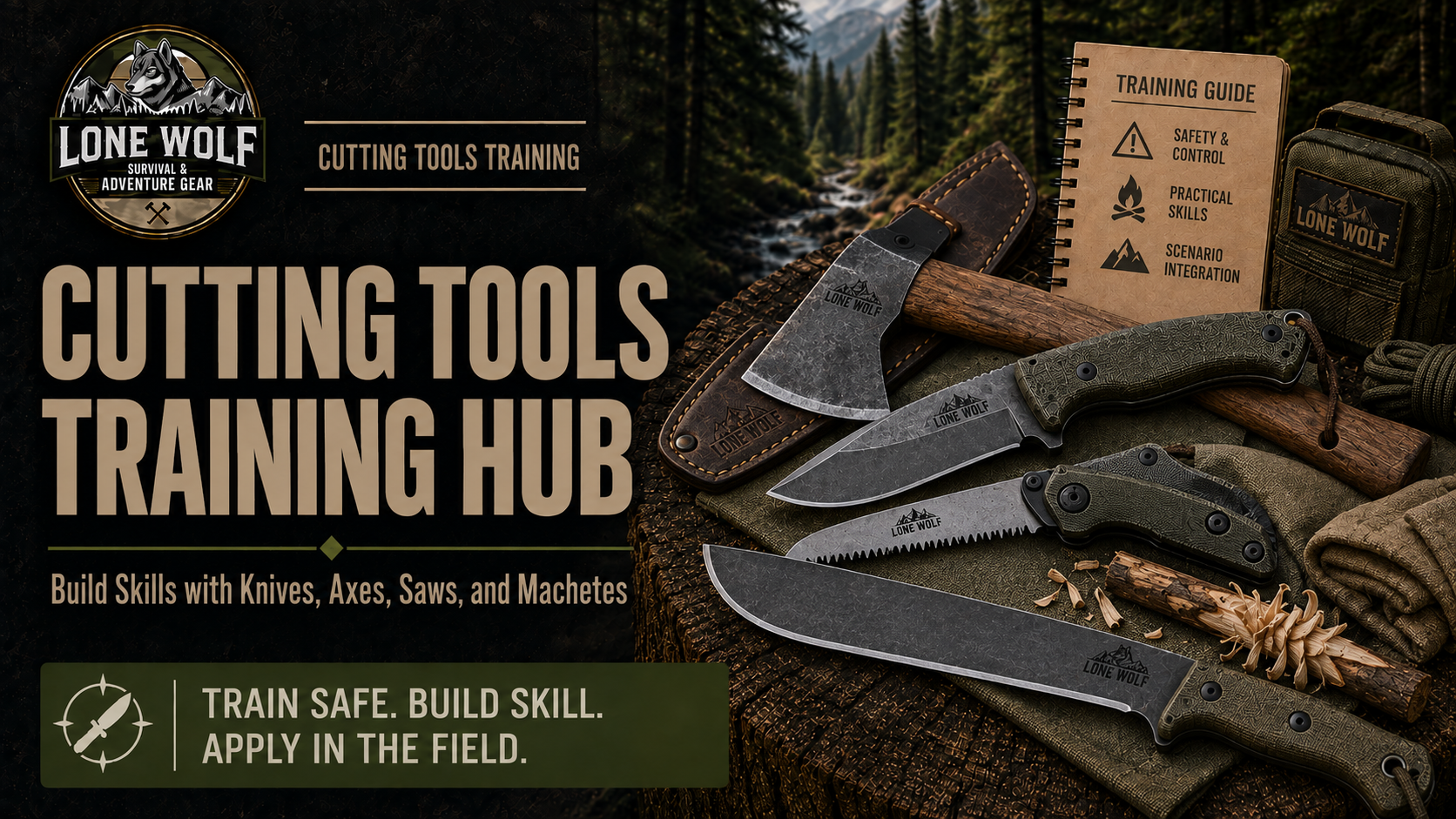
Cutting tools are essential for many survival tasks, from preparing wood and building shelter to processing materials and completing other work that requires controlled cutting. Proper training teaches you how to match the tool and technique to the task, work safely under changing conditions, and maintain control throughout the work.
The Cutting Tools Training Hub is the domain level entry point for training across the four major cutting tools branches. Use the links below to go directly to the training hub for each branch:
The hub brings those separate training branches together under one structure. It explains how Cutting Tools training is organized, introduces the common three layer training framework, and directs readers to the branch that matches the tool they want to train with.
Detailed training remains within the individual branches. The Cutting Tools Training Hub provides the domain level orientation needed to understand how those branch training systems fit together and where to continue.
Start Here
This article is organized into the following major sections:
- Training Overview and Fundamentals
- Training Hub Learning Pathway
- The Three Training Layers
- Cutting Tools Branch Training
- Key Takeaways
- Conclusion
Use the first three sections to understand how Cutting Tools training is organized at the domain level, how the learning pathway guides your progression, and how the three training layers structure skill development.
From there, continue into the branch that matches the cutting tool you want to train with. Each branch contains the detailed training for that tool category, while the Cutting Tools Training Hub keeps the four branches connected under one domain level training structure.
Use the Jump To links below to go directly to any section.
Training Overview and Fundamentals
Cutting Tools domain training helps you develop the knowledge, skills, and control you need to use survival knives, axes and hatchets, saws, and machetes safely and effectively.
Training across the domain is built around several fundamentals:
- Safety comes first. Every cutting tool can cause serious injury. Training begins with safe handling, work area control, body position, edge awareness, and stopping conditions.
- The task determines the tool and technique. Training should prepare you to identify the work that needs to be done, choose the appropriate cutting tool, and use a technique suited to the task and conditions.
- Control comes before speed or power. Safe, deliberate movement and consistent tool control form the foundation for more advanced skills.
- Skills improve through practice. Repetition under controlled conditions helps develop coordination, consistency, and confidence before those skills are used in more demanding situations.
- Training should reflect realistic conditions. As skills improve, practice should account for changing terrain, weather, available materials, fatigue, limited space, and other conditions that can affect cutting tasks.
- Tool care supports safe performance. A properly maintained cutting tool is easier to control and more effective to use. Training includes the inspection and maintenance habits needed to keep each tool ready for use.
The same basic training principles apply across the Cutting Tools domain, but the detailed skills differ by tool. Survival knives, axes and hatchets, saws, and machetes each require their own techniques, safety practices, and progression of training.
The individual branch training hubs provide the detailed training for each cutting tool category.
Training Hub Learning Pathway
The Training Hub Learning Pathway shows the path from the domain level training structure into the branch that matches the cutting tool you want to train with.
- Begin with the domain level training fundamentals. Understand the safety principles, task requirements, tool control, and training expectations that apply across the Cutting Tools domain.
- Choose the appropriate cutting tool branch. Continue into Survival Knife Training, Axes & Hatchets Training, Saws Training, or Machetes Training based on the tool you want to study.
- Progress through the three training layers within that branch. Begin with Safety & Control, move into Practical Skills, and then apply those skills through Scenario Integration. Each branch applies the three layers to the techniques, tasks, and safety requirements of that cutting tool category.
- Return to the Cutting Tools Training Hub when you are ready to expand your training. Use the hub to continue into another branch and build additional capability across the Cutting Tools domain.
You can follow the pathway in order, or go directly to a specific branch, training layer, or skill when you already know what you want to learn or practice.
The pathway connects the common domain level training framework to the detailed training within each cutting tool branch.
The Three Training Layers
Cutting Tools training is organized into three layers. Each layer builds on the one before it and gives you a clear progression from basic safety and control to practical skill development and realistic application.
-
Layer 1: Safety & Control
Establishes the safe handling habits, body position, work area control, tool awareness, and basic movements needed before you begin more demanding cutting tasks. -
Layer 2: Practical Skills
Develops the techniques needed to complete common cutting tasks with the appropriate tool. This layer focuses on building consistent, controlled performance through practice. -
Layer 3: Scenario Integration
Applies the skills from Layers 1 and 2 to realistic situations where the task, environment, available materials, and other conditions affect how the work is performed.
The same three layer structure applies across Survival Knives, Axes & Hatchets, Saws, and Machetes. Each branch uses the framework to organize training around the specific tasks, techniques, and safety requirements of that cutting tool category.
Cutting Tools Branch Training
The four cutting tools branches use the same three layer training framework, but each branch applies it to different tools, tasks, and techniques.
- Survival Knives: controlled cutting, carving, notching, batoning, feather sticks, and other common survival knife skills.
- Axes & Hatchets: chopping, splitting, shaping, limbing, and other common axe and hatchet skills.
- Saws: safe sawing techniques, material support, cut control, and common survival sawing tasks.
- Machetes: clearing, chopping lighter vegetation, controlled cutting, and other machete specific tasks.
Each branch has its own training hub where the detailed Layer 1, Layer 2, and Layer 3 training is organized. The Cutting Tools Training Hub connects those branch training systems at the domain level and directs readers to the training they want to follow for each tool category.
Key Takeaways
- Training in the Cutting Tools domain helps you develop the knowledge, skills, and control needed to use survival knives, axes and hatchets, saws, and machetes safely and effectively.
- The Cutting Tools Training Hub provides the domain level training structure and directs readers into the appropriate branch.
- Training follows three layers: Safety & Control, Practical Skills, and Scenario Integration.
- The four cutting tools branches use the same three layer framework, but each branch applies it to different tools, tasks, techniques, and safety requirements.
- Readers can follow the Training Hub Learning Pathway in order or go directly to a specific branch, training layer, or skill when they already know what they want to learn or practice.
- Detailed training is organized within the individual branch training hubs.
Conclusion
Cutting Tools training helps you build the knowledge, skills, and control needed to use survival knives, axes and hatchets, saws, and machetes safely and effectively.
The Cutting Tools Training Hub organizes that training at the Cutting Tools domain level. Each cutting tool category uses the same three training layers: Safety & Control, Practical Skills, and Scenario Integration. The branch training hubs apply those layers to the specific tools, tasks, techniques, and safety requirements within each category.
From here, continue into the Training Hub Learning Pathway or go directly to the Survival Knife, Axes & Hatchets, Saws, or Machetes Training Hub based on what you want to learn or practice next.
Continue Learning
Continue building your Cutting Tools training with these related Lone Wolf resources:
