
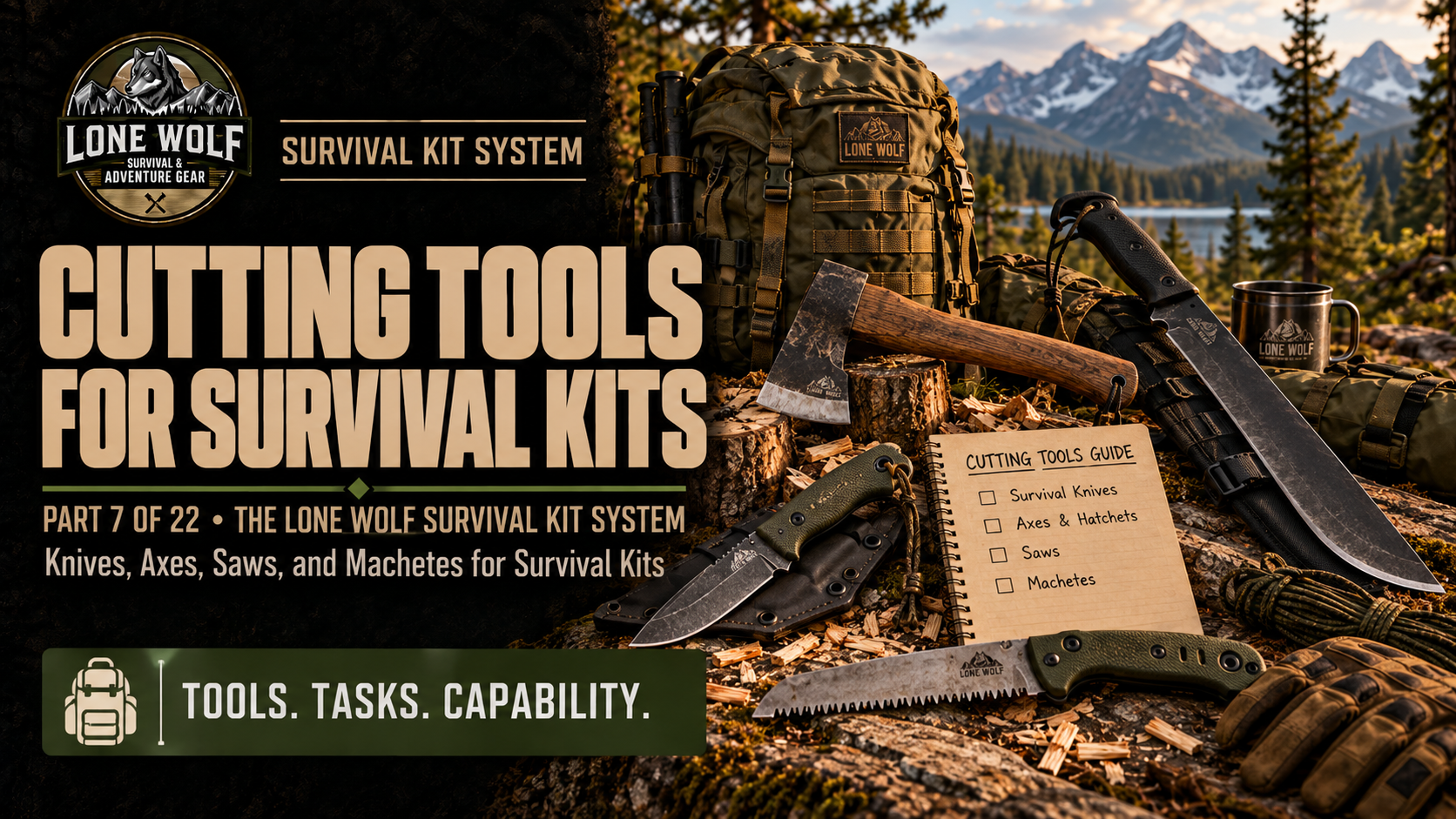
Cutting Tools for Survival Kits
Knives, Axes, Saws, and Machetes
Part 7 of 22 • The Lone Wolf Survival Kit System
Introduction
Cutting tools are some of the most useful tools in a survival kit. They support shelter work, fire preparation, food preparation, repairs, cordage cutting, wood processing, vegetation clearing, and many other survival tasks.
Survival knives form the foundation of your cutting capability. Axes and hatchets, saws, and machetes add different types of capability when the tasks, environment, workload, or conditions require more than your knife system can efficiently provide.
The Lone Wolf System of Threes provides the baseline with a three-knife system built around redundancy, flexibility, and versatility. The Lone Wolf Cutting Tool System expands that baseline by adding axes, hatchets, saws, or machetes when they fill a real capability gap.
This article will help you choose and organize cutting tools based on the survival tasks you expect to perform, the role of the kit, the environment, weight and bulk, carry method, access, training, and skill.
Which Camping Tool To Use
You Are Here
Survival Foundations Gateway
Survival Training Gateway
Survival Gear Gateway
Survival Kits Domain
The Lone Wolf Survival Kit System Hub
Cutting Tools for Survival Kits
Start Here
Build your cutting tool loadout around the work your survival kit may need to support.
Start with the three-knife baseline provided by The Lone Wolf System of Threes. Then identify any cutting tasks that require more capability than those knives can provide efficiently.
This article covers:
- Building Your Cutting Tool Loadout
- Survival Cutting Tasks
- The Lone Wolf System of Threes
- Survival Knives
- Axes & Hatchets
- Saws
- Machetes
- Adding Cutting Capability
- Redundancy, Tool Overlap, and Capability Gaps
- Kit Role and Environment
- Weight, Bulk, and Carry
- Access and Organization
- Training and Skill
- Interactive Exercise: Build and Adapt Your Cutting Tool Loadout
- Test Your Cutting Tool Loadout
- Quick Decision Guide
- Key Takeaways
- Conclusion
Read the sections in order when building a cutting tool loadout from the beginning. Use the Jump To section when you need help with a specific decision.
Jump To
- Building Your Cutting Tool Loadout
- Survival Cutting Tasks
- The Lone Wolf System of Threes
- Survival Knives
- Axes & Hatchets
- Saws
- Machetes
- Adding Cutting Capability
- Redundancy, Tool Overlap, and Capability Gaps
- Kit Role and Environment
- Weight, Bulk, and Carry
- Access and Organization
- Training and Skill
- Interactive Exercise: Build and Adapt Your Cutting Tool Loadout
- Test Your Cutting Tool Loadout
- Quick Decision Guide
- Key Takeaways
- Conclusion
Building Your Cutting Tool Loadout
A cutting tool loadout should provide the capability required for the survival tasks your kit is designed to support while keeping weight, bulk, and carrying requirements under control.
The Lone Wolf System of Threes provides the baseline with a three-knife system built around redundancy, flexibility, and versatility.
The Lone Wolf Cutting Tool System expands that baseline with axes and hatchets, saws, and machetes when additional capability is needed.
The Lone Wolf Cutting Tool System
The four major cutting tool categories are:
- Survival Knives
- Axes & Hatchets
- Saws
- Machetes
Each category provides a different type of cutting capability. Knives provide the baseline. Axes and hatchets add heavier chopping and splitting. Saws provide efficient wood cutting. Machetes provide reach and efficient vegetation cutting.
Choose tools that match the work your kit may need to perform and the conditions in which you expect to use them.
Survival Cutting Tools For Emergencies
Survival Cutting Tasks
Cutting-tool selection begins with the tasks.
Identify the cutting work your survival kit may need to support and consider:
- The material being cut
- The size and thickness of the material
- The amount of cutting required
- How often the task may be performed
- The environment in which the work will occur
Cutting cordage, preparing food, and opening packaging require far less cutting capability than processing firewood, building shelter components, or clearing dense vegetation.
Once you understand the tasks, compare them with the capability of your three-knife system. Add another cutting tool when a meaningful capability gap remains.
The Lone Wolf System of Threes
The Lone Wolf System of Threes uses a three-knife system to provide redundancy, flexibility, and versatility.
The knives can differ in size, design, carry method, and intended use. Each knife should add something useful to the system while preserving backup capability if another knife is lost, damaged, inaccessible, or poorly suited to a particular task.
The three-knife system also provides the starting point for deciding whether additional cutting tools are needed.
If the knife system handles the expected cutting tasks efficiently, the cutting loadout may already provide enough capability.
If an important task remains difficult or inefficient, identify the missing capability and select the tool that best fills that gap.
Survival Knives
Survival knives form the core of the cutting tool system because they support a broad range of tasks while remaining relatively compact and easy to carry.
Different knives can serve different roles. One may handle general cutting and food preparation, another may be better suited for heavier work, and another may provide a smaller or more convenient cutting option.
Build the three-knife system around:
- Expected cutting tasks
- Environment
- Carry method
- Access
- Personal preference
- Training and skill
The goal is a three-knife system that provides useful differences in capability while maintaining redundancy, flexibility, and versatility.
10 Bushcraft Knife Skills in 10 Minutes
Axes & Hatchets
Axes and hatchets add chopping and splitting capability when your expected workload includes repeated wood processing or tasks that require more force than your knives can provide efficiently.
A hatchet is smaller, lighter, and easier to carry. It works well for smaller wood-processing tasks and controlled swings in limited space.
An axe provides greater reach, leverage, and power. It is better suited to larger or more frequent wood-processing tasks but adds more length, weight, and bulk.
Choose between them by considering:
- Size of the wood
- Amount of processing
- Need for chopping and splitting
- Available carrying space
- Total kit weight
- Training and control
An axe or hatchet earns its place when its added capability justifies the carrying cost.
10 Bushcraft Axe Skills in 10 Minutes
Saws
Saws provide efficient wood cutting by making controlled cuts across the grain.
For cutting branches, poles, and firewood to length, a saw can often perform the task with less effort and less working space than repeated chopping.
Common survival-kit options include:
- Folding saws
- Compact bow saws
- Pocket chainsaws
- Other compact saw designs
Folding saws provide a useful balance between cutting capacity and portability. Larger saws increase cutting capacity but require more space.
Saws overlap with axes and hatchets in wood processing, but they perform different jobs especially well. A saw cuts wood to length efficiently. An axe or hatchet provides chopping and splitting capability.
Carry both when the expected workload justifies the added capability and weight.
10 Bushcraft Saw Skills in 10 Minutes
Machetes
Machetes provide reach and efficient cutting for brush, vines, tall grass, and other vegetation.
Blade length, weight, thickness, balance, and shape affect how a machete performs. Lighter machetes work well for repeated vegetation cutting. Heavier designs provide more chopping force and may handle light wood processing.
The strongest reason to carry a machete is frequent vegetation cutting.
In environments with dense brush, vines, tall grass, or similar growth, a machete can fill a capability gap that knives, saws, and hatchets handle less efficiently.
How to cut with a machete
Adding Cutting Capability
Start with the three-knife system.
Add another cutting tool when the expected tasks require capability that the knife system does not provide efficiently.
Ask:
- What task creates the capability gap?
- What material needs to be cut?
- How much cutting is required?
- Which tool fills the gap most efficiently?
- Does the added capability justify the weight and bulk?
- Can the tool be carried securely and accessed when needed?
- Do you have the training to use it effectively?
An axe, hatchet, saw, or machete should have a clear reason for being in the kit.
Redundancy, Tool Overlap, and Capability Gaps
Useful redundancy gives you more than one way to complete important cutting tasks.
Tool overlap becomes excessive when several tools add weight and bulk while providing nearly the same capability.
Capability gaps create the opposite problem. An important cutting task remains poorly supported.
For example:
- Repeated wood processing may justify adding a saw or hatchet.
- Splitting larger wood may justify a hatchet or axe.
- Dense vegetation may justify a machete.
- Light general-purpose cutting may already be covered by the knife system.
The goal is a cutting tool system with useful redundancy, limited unnecessary overlap, and enough capability for the expected tasks.
Kit Role and Environment
The role of the survival kit affects how much cutting capability makes sense.
An EDC (everyday carry) setup places a high priority on portability and access.
A get home bag may need enough cutting capability for movement, short-term survival tasks, and unexpected delays.
A bug out bag may justify additional cutting capability when travel, shelter work, wood processing, or vegetation increases the workload.
A larger long-duration kit may support more cutting tools when repeated use justifies the additional weight.
Environment also changes the decision.
- Wooded areas may increase the usefulness of a saw, axe, or hatchet.
- Dense vegetation may increase the need for a machete.
- Urban or vehicle-based kits may favor smaller, easier-to-carry tools.
Match the cutting system to both the kit role and the environment.
Weight, Bulk, and Carry
Every cutting tool adds weight, takes space, and creates another carrying requirement.
Weight affects endurance and the total equipment you can carry.
Bulk affects pack organization and available space.
Carry method determines where the tool rides, how secure it remains, and how easily you can reach it.
Long handles, large blades, and rigid frames may create carrying problems even when the tool itself is relatively light.
Evaluate each cutting tool as part of the complete survival kit rather than in isolation.
Access and Organization
Cutting tools need to be secure, protected, and accessible.
Frequently used tools should be reachable without unloading the pack.
At least one knife should be readily accessible.
Use sheaths, blade covers, secure attachment points, and dedicated storage locations to protect cutting edges and prevent tools from damaging other equipment.
Larger tools carried outside the pack should remain tight against it and avoid swinging, shifting, or snagging.
Heavier tools should also be positioned with pack balance in mind.
A good load plan keeps cutting tools safe, accessible, and practical to carry.
Training and Skill
Every cutting tool requires knowledge, control, and practice.
Knives, axes and hatchets, saws, and machetes use different techniques and create different hazards.
The Lone Wolf Cutting Tools training structure develops skill through three layers:
- Layer 1: Safety & Control — safe handling and basic control
- Layer 2: Practical Skills — common cutting tasks developed through practice
- Layer 3: Scenario Integration — applying those skills under changing conditions and realistic survival problems
Build skills with the tools you plan to carry.
Training increases the capability of the tool because you can use it more safely, efficiently, and effectively.
Interactive Exercise: Build and Adapt Your Cutting Tool Loadout
Begin with the starting conditions below. At each stage, the situation changes. Decide whether your current cutting tool system still provides enough capability or whether another tool should be added.
Starting Conditions
You are building a survival kit for one person. The kit may need to support short-term travel, shelter work, fire preparation, food preparation, cordage cutting, equipment repair, and other general survival tasks.
You begin with a three-knife system based on The Lone Wolf System of Threes.
What should you evaluate before adding another cutting tool?
Show Answer
Start with the survival cutting tasks the kit needs to support.
Consider:
- Materials
- Size and thickness
- Amount of cutting
- Frequency of use
- Environment
- Kit role
- Weight and bulk
- Carry method
- Access
- Training and skill
If the three-knife system provides the required capability, additional tools may add little useful capability. If a gap remains, identify the tool that best fills it.
Change 1: Wood Processing Increases
The kit will now be used in a heavily wooded area. You expect to build fires regularly and may need to cut branches and small logs to length.
What should you consider adding?
Show Answer
A saw becomes more useful because repeated wood cutting is now an important task.
A folding saw can provide efficient cutting with relatively little weight and bulk. A larger saw may provide more capacity when the expected workload justifies the added size.
Change 2: Splitting and Chopping Become Important
You now expect to process larger pieces of wood and split wood regularly for fire preparation.
Does the saw provide all the capability you need?
Show Answer
The saw handles cutting wood to length efficiently. Splitting and heavier chopping create a different capability requirement.
A hatchet or axe may now fill that gap.
A hatchet provides a more compact option. An axe provides greater reach, leverage, and power for heavier work.
Change 3: The Environment Changes
Your route changes from open woodland to an area with heavy brush, vines, tall grass, and dense vegetation.
What new cutting capability may be needed?
Show Answer
A machete may provide the needed vegetation-cutting capability because its reach, blade length, and repeated cutting efficiency make it well suited to brush and dense growth.
Environment has changed the cutting requirements.
Change 4: The Load Becomes Too Heavy
Your cutting system now includes:
- Three knives
- A folding saw
- A hatchet
- A machete
The complete survival kit has become heavier and more difficult to carry over distance.
What should you do?
Show Answer
Review the system by task and capability.
Determine which tools provide unique capability, where useful overlap exists, and where several tools are performing nearly the same work.
Keep the tools that support the expected tasks and remove cutting capability that adds more weight and bulk than the situation requires.
Change 5: The Tools Exceed Your Skill
Your loadout includes an axe, saw, and machete, but you have very little experience using the axe and machete.
Should they remain in the kit simply because they provide more capability?
Show Answer
Training is part of cutting-tool capability.
Build skills with the tools you plan to carry. Training should include safe handling, practical cutting tasks, access and stowing, and realistic use.
The cutting tool system should match both the tasks you expect to perform and your ability to use the tools effectively.
Final Decision
What is the main lesson from the exercise?
Show Answer
Build the cutting tool system around required capability.
Start with the three-knife baseline. Add an axe or hatchet, saw, or machete when the survival cutting tasks, environment, workload, or conditions create a capability gap.
Evaluate every additional tool against:
- Capability
- Redundancy
- Tool overlap
- Weight
- Bulk
- Carrying
- Access
- Environment
- Kit role
- Training and skill
The strongest cutting tool loadout provides the capability you need while remaining practical to carry, access, control, and use.
Test Your Cutting Tool Loadout
Once the loadout is selected, test the complete system.
Create a load plan that identifies where each tool will be carried and how it will be returned to that position after use.
Begin in a controlled setting. Pack the kit, remove each cutting tool, use the access points, and stow the tools again.
Check:
- Access
- Secure carrying
- Weight distribution
- Pack balance
- Interference with other equipment
- Ease of stowing
- Comfort while moving
Then test the kit under realistic conditions.
Carry it over terrain similar to what you expect to encounter. Practice the cutting tasks the kit is designed to support using the actual tools you plan to carry.
Conditions such as heat, cold, rain, mud, uneven terrain, steep ground, brush, and fatigue can expose problems that remain hidden during an indoor test.
After each training session, review the system, correct problems, and test the changes again.
Quick Decision Guide
What cutting tasks are you preparing for?
Identify the tasks that require cutting capability.
Does your three-knife system cover those tasks?
If it does, additional tools may add little capability. If a gap remains, identify it.
Which tool fills the gap?
Choose an axe or hatchet, saw, or machete based on the task, material, environment, and workload.
Does the tool create excessive overlap?
Keep useful redundancy while controlling unnecessary duplication.
Does it fit the kit role and environment?
Match the tool system to how and where the kit will be used.
Can you carry the added weight and bulk?
Evaluate the tool as part of the complete kit.
Can you access and stow it safely?
Include every cutting tool in the load plan.
Have you trained with it?
Build the skill required to use the tool safely and effectively.
Have you tested the complete setup?
Carry the kit, use the tools, and refine the system.
Key Takeaways
- The Lone Wolf System of Threes provides the baseline cutting capability with a three-knife system built around redundancy, flexibility, and versatility.
- The Lone Wolf Cutting Tool System adds axes and hatchets, saws, and machetes when additional capability is required.
- Cutting tasks come first.
- Add tools to fill capability gaps.
- Control unnecessary overlap, weight, and bulk.
- Match the cutting system to the kit role and environment.
- Secure and organize every tool as part of the complete load plan.
- Build skills with the tools you carry.
- Test the loadout under realistic conditions.
- Match the cutting tool to the task. Match the tool to the kit.
Conclusion
A survival cutting tool system should provide the capability required for the tasks your kit is designed to support while remaining practical to carry and use.
The Lone Wolf System of Threes establishes the baseline with three knives that provide redundancy, flexibility, and versatility.
Axes and hatchets, saws, and machetes expand that capability when the expected tasks, materials, environment, or workload create a need for more specialized cutting tools.
Build the system around the tasks first. Identify capability gaps, select tools that fill those gaps, control unnecessary overlap, and account for weight, bulk, carrying, access, training, and skill.
Then test the complete loadout. Carry it, use the tools, practice access and stowing, and refine the system until the cutting tools work as part of the survival kit rather than as a collection of separate pieces of gear.
