
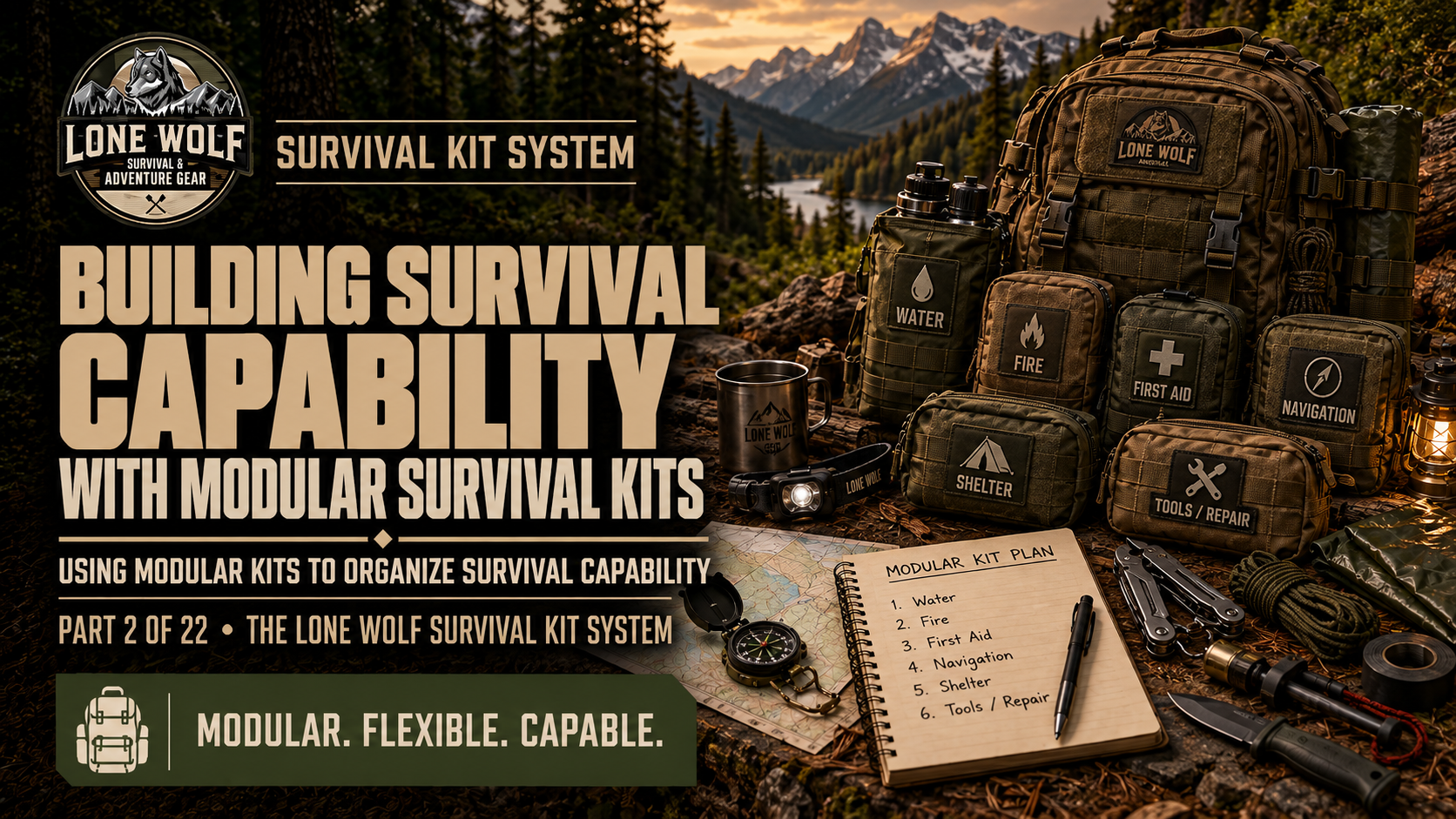
Building Survival Capability with Modular Survival Kits
Building Your Modular Survival Kit
Part 5 of 22 — The Lone Wolf Survival Kit System
You Are Here
- Survival Foundations Gateway
- Survival Training Gateway
- Survival Gear Gateway
- Survival Kits Domain
- The Lone Wolf Survival Kit System
- Building Survival Capability with Modular Survival Kits
Jump To
- Introduction
- Start Here
- What Makes a Survival Kit Modular
- Decide Which Modules Belong in the Base Kit
- Build the Base Kit
- Build Individual Modules
- Build Situation Specific and Custom Modules
- Add, Remove, and Change Modules
- Interactive Exercise: Adapt the Modular Kit
- Organizing Modular Kit Redundancy
- Conclusion
Introduction
A modular survival kit organizes equipment and supplies into functional groups that can be added, removed, replaced, or upgraded as your needs change.
Part 4 established what the survival kit needs to do for the person using it and the situation for which it is being planned. Part 5 uses those requirements to build a modular system.
The modules required for the kit to fulfill its defined purpose make up the base kit. Additional modules can then be added when the situation, environment, duration, or personal requirements create a need for additional capability.
This article explains how to choose the modules that belong in the base kit, build individual modules, create modules for changing conditions or personal requirements, and organize redundancy throughout the kit.
Start Here
A modular survival kit allows you to change part of the kit without rebuilding everything. The structure begins with a base kit that supports its defined purpose, then adds or removes modules as conditions and requirements change.
Article Outline
- What Makes a Survival Kit Modular
- Decide Which Modules Belong in the Base Kit
- Build the Base Kit
- Build Individual Modules
- Build Situation Specific and Custom Modules
- Add, Remove, and Change Modules
- Interactive Exercise: Adapt the Modular Kit
- Organizing Modular Kit Redundancy
This article covers:
- Modular organization — How equipment and supplies can be organized into functional groups that can be changed independently.
- The base kit — How to determine which modules must remain with the kit for it to fulfill its purpose.
- Individual modules — How to organize equipment and supplies around a survival capability or requirement.
- Situation specific and custom modules — How to add capability for particular environments, conditions, durations, or personal needs.
- Changing the modular kit — How to add, remove, replace, and upgrade modules as requirements change.
- Redundancy — How to distribute the tools used within The Lone Wolf System of Threes so one loss does not remove all three.
Use these sections to organize the capabilities and priorities established in Parts 3 and 4 into a practical modular survival kit.
What Makes a Survival Kit Modular
A modular survival kit organizes equipment and supplies into functional groups that can be added, removed, replaced, or upgraded without rebuilding the entire kit.
A module may focus on one survival capability, such as water, fire, medical, or communications. It may also combine equipment from several capabilities when those items work together for a particular condition or situation.
The primary advantage is flexibility. You can improve one module as your equipment, skills, priorities, or budget change while leaving the rest of the kit alone.
A module is a functional grouping rather than a requirement that every related item remain inside one pouch. Equipment may be distributed elsewhere in the kit or carried on your person when access, redundancy, balance, or use makes that arrangement more practical.
Modular construction gives you a structured way to build the kit in sections and change those sections as requirements change.
Bug Out Bag: Modular Organization — TheUrbanPrepper
Decide Which Modules Belong in the Base Kit
The base kit contains the modules required for the survival kit to fulfill its defined purpose. Additional modules support requirements that apply only under particular conditions.
Start with the kit purpose and survival capability priorities established in Part 4. Identify the capabilities the kit must provide whenever it is used.
If a capability is required for the kit to fulfill its purpose, the module supporting that capability belongs in the base kit.
If the capability is needed only for a particular season, environment, duration, medical requirement, or other condition, it can remain an additional module and be added when needed.
The decision can usually be reduced to two questions:
- Is this capability required for the kit to fulfill its defined purpose? If yes, include the module in the base kit.
- Is the capability required only under certain conditions? If yes, keep it as an additional module and add it when those conditions apply.
These decisions establish the structure of the modular kit before the individual modules are built.
Build the Base Kit
Once you know which modules belong in the base kit, assemble them into the basic survival kit.
Review the survival tasks the kit is expected to support and confirm that the selected modules provide the equipment and supplies needed to complete those tasks.
Next, determine the appropriate level for each module. Good, Better, and Best represent different levels within the same type of module. The equipment and supplies that distinguish those levels depend on the capability being supported.
Every module does not have to use the same level. One may be Good, another Better, and another Best according to capability requirements, priorities, and budget. Individual modules can be upgraded later without rebuilding the entire kit.
Review the completed base kit as a system. Confirm that required capabilities are covered, the modules work together, and important equipment or supplies have not been omitted between them.
Build Individual Modules
Each module should have a clear purpose. Begin with the capability or requirement the module must support, identify the survival tasks connected to it, and then select the equipment and supplies needed to complete those tasks.
A water module, for example, can be built around obtaining, carrying, and making water safe to drink. A fire module can support starting, maintaining, and using fire. Detailed equipment choices belong in the later capability articles, but the module begins with the tasks it must support.
Keep the module focused while allowing related equipment to be distributed elsewhere when access, redundancy, balance, or use makes another location more practical.
Build modules so they can be inspected, replaced, or upgraded individually. That allows one part of the kit to improve without forcing changes to modules that already meet their requirements.
Water Module | Urban Bug Out Bag | Version 3.0 — TheUrbanPrepper
Build Situation Specific and Custom Modules
Some requirements involve several survival capabilities at the same time. A situation specific module combines additional equipment and supplies needed for a particular condition, environment, duration, or event.
Begin by identifying what changes when that condition occurs. Cold weather, heavy rain, extended travel, or another situation may increase requirements across several capabilities. Build the module around those additional requirements.
Custom modules address the needs of the person using the kit. Medical needs, mobility limitations, responsibilities for another person, or other personal requirements may justify equipment organized specifically for that user.
Equipment required every time the kit is used belongs in the base kit. Equipment required only because of a particular situation or personal requirement can remain separate and be added when needed.
Urban Shelter | Design Strategy | Urban BOB v3.0 — TheUrbanPrepper
Add, Remove, and Change Modules
One of the main advantages of a modular survival kit is the ability to change individual parts of the kit as requirements change.
Modules required for the kit's defined purpose remain in the base kit. Additional modules are added when a new condition creates requirements the base kit does not cover.
A cold-weather module, for example, can add clothing, insulation, fire capability, shelter components, or other equipment when winter conditions require them. When those conditions no longer apply, the module can be removed.
Modules can also be upgraded individually. A Good module can be replaced with a Better or Best version, or revised as equipment wears out, skills improve, priorities change, or capability requirements develop.
Every change should be followed by a review of the complete kit. Added capability also adds weight, bulk, and organizational demands.
The Most EFFICIENT Survival Kit I Have Ever Seen
Interactive Exercise: Adapt the Modular Kit
Begin with the starting conditions below. At each stage, the situation changes. Decide which parts of the modular kit should remain, which should change, and whether a new module is needed before revealing the answer.
Starting Conditions
You are building a survival kit for one healthy adult traveling by vehicle in a rural area during mild spring weather. The kit needs to support an unexpected breakdown, short-term shelter, water, fire, medical needs, navigation, communication, lighting, and basic cutting tasks for approximately 24 hours.
Which modules belong in the base kit?
Show Answer
Begin with the capabilities required every time this kit is used. Modules supporting water, fire, shelter, medical needs, navigation, communications, lighting, cutting tools, and other requirements identified during Parts 3 and 4 belong in the base kit when they are necessary for the kit's defined purpose.
Keep the initial kit focused on the requirements that apply under the normal conditions for which it is being built.
Change 1: Winter Arrives
The same vehicle will now be used during winter. Overnight temperatures may fall below freezing, snow is possible, and travel delays may last longer.
What should change?
Show Answer
Keep the base modules that remain necessary and add capability for the new conditions. A cold-weather module could add insulation, additional clothing, stronger shelter support, cold-weather fire supplies, hand protection, and other equipment identified through winter planning.
Water storage and equipment affected by freezing temperatures should also be reviewed. The change in environment modifies the kit without requiring the entire base kit to be rebuilt.
Change 2: The Trip Becomes Longer
The vehicle trip now takes you into a more isolated area where assistance could take two or three days instead of 24 hours.
What does the modular system need to address?
Show Answer
Longer duration increases requirements for water, food, medication, power, sanitation, and other consumable or time-dependent resources.
Some existing modules may need greater capacity, while an additional duration or resupply module may be useful. Review the complete kit after making those changes because additional supplies increase both weight and bulk.
Change 3: Another Person Joins You
A second person will now travel with you. That person takes daily medication and has limited mobility.
What changes?
Show Answer
The kit now has personal requirements that were absent from the original design. Add the required medication, medical supplies, and any equipment needed to support the second person's mobility and other needs.
Some of those items may form a custom module. Water, food, shelter, and other shared capabilities also need to be reviewed because the kit now supports two people.
Change 4: The Kit Becomes Too Heavy
After the winter, extended-duration, and personal modules are added, the kit becomes too heavy for the people expected to carry it comfortably.
What should you do?
Show Answer
Review the kit by capability and purpose rather than removing items at random.
Confirm which modules are required under the actual conditions, eliminate unnecessary duplication, look for lighter ways to provide the same capability, and remove situation-specific modules whose conditions do not apply.
The goal is to preserve the required survival capability while keeping the complete kit practical to carry and use.
Change 5: One Module Is Lost
During movement, one pouch is lost. All three fire-starting tools were stored inside it.
What planning problem does this reveal?
Show Answer
The fire-starting tools provided redundancy inside the pouch, but storing all three together created a single point of failure.
Distribute the tools used within The Lone Wolf System of Threes so one lost pouch, damaged compartment, or inaccessible part of the kit cannot remove the entire capability at once.
Final Decision
What is the central lesson from the changing conditions?
Show Answer
A modular survival kit should change when its requirements change. The base kit provides the capabilities required for its defined purpose, while additional modules adapt it to different environments, durations, situations, and personal needs.
Each change should be evaluated as part of the complete system so added capability does not create unnecessary weight, poor organization, or new single points of failure.
Organizing Modular Kit Redundancy
Redundancy reduces dependence on a single tool. If one tool is lost, damaged, inaccessible, or fails, another remains available to help complete the survival task.
The Lone Wolf System of Threes uses three tools within each survival domain to create redundancy, flexibility, and versatility. The tools can have different strengths and functions while still providing backup capability within the domain.
The three tools should also be distributed rather than stored together. One may be carried on your person, another in the primary module for that survival domain, and the third in another pouch or compartment.
This prevents one lost or damaged module from removing all three tools at once.
Survival knives provide one example. A three-knife system can use knives with different sizes, designs, and strengths selected around the survival tasks, environment, carry method, and user. The specific knives can vary while the three-tool structure provides redundancy, flexibility, and versatility.
Apply the same principle throughout the other survival domains while organizing the tools according to how they need to be carried, accessed, and used.
Fire Module | Urban Bug Out Bag | Version 3.0 — TheUrbanPrepper
Conclusion
A modular survival kit provides a structured way to organize the capabilities identified in Part 3 and prioritized for the kit in Part 4.
The modules required for the kit's defined purpose form the base kit. Additional modules allow the kit to adapt when the environment, duration, situation, or personal requirements change.
Individual modules can also be inspected, replaced, or upgraded without rebuilding the rest of the kit. The complete kit should be reviewed whenever modules change so capability, weight, organization, and accessibility remain balanced.
Redundancy should be distributed throughout the modular system. The tools used within The Lone Wolf System of Threes should be organized so one lost pouch or compartment does not remove all three tools at once.
Once the modules and contents of the survival kit are established, the next step is choosing the backpack that will carry them. Part 6: How to Choose a Survival Kit Backpack explains how to select a backpack that fits the size, weight, organization, and carrying requirements of the kit.
