
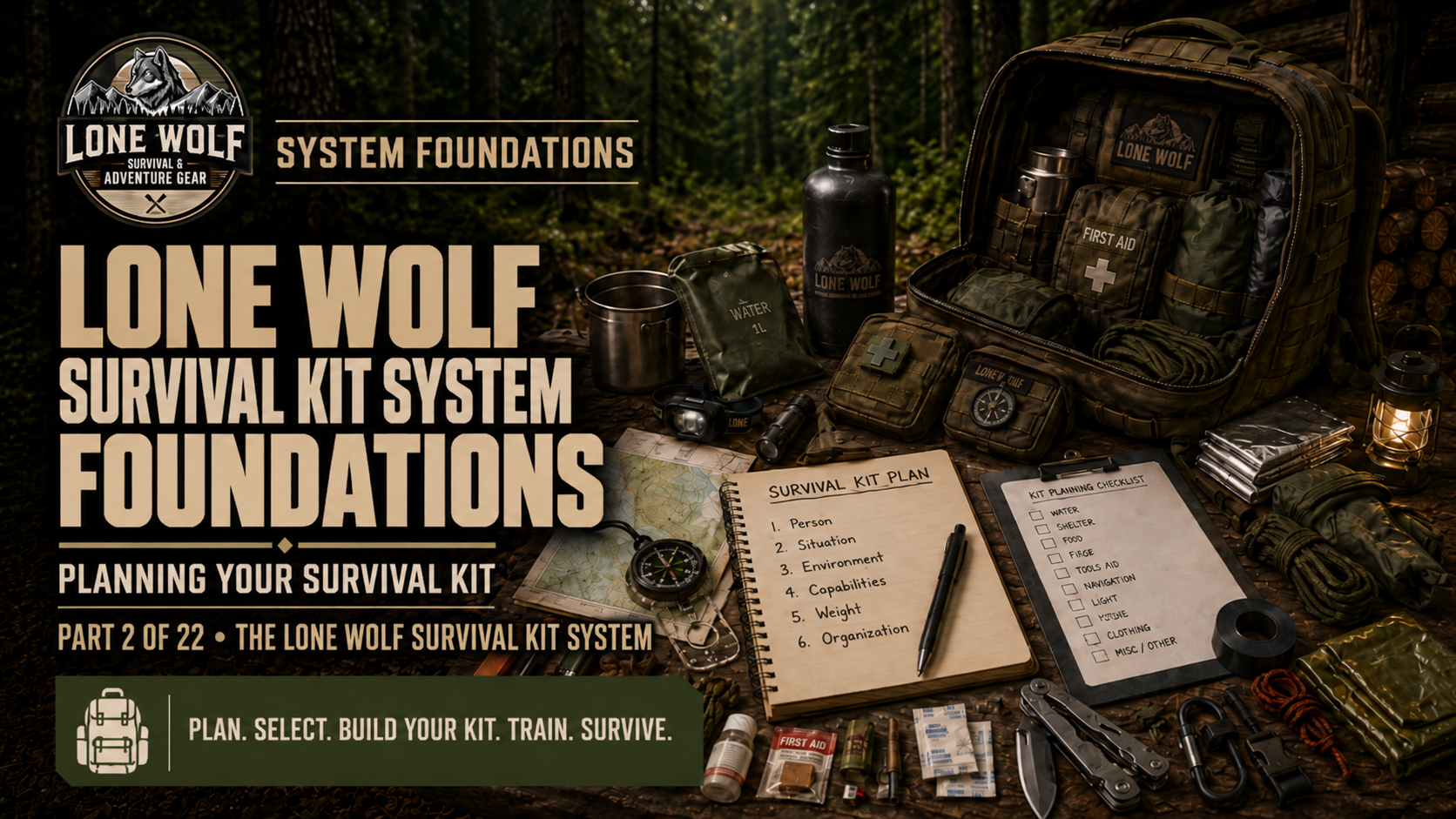
Planning Your Survival Kit
Survival Kit Planning
Part 2 of 22 — The Lone Wolf Survival Kit System
You Are Here
Introduction
The purpose of Planning Your Survival Kit is to establish the basic considerations used when planning your survival kit.
Effective survival kit planning considers the person who will use the kit, the survival situation, and the environment. It also considers mindset, weight, and mobility because each of these affects what you can carry, what you can use effectively, and what your kit needs to support.
This article explains how those foundations apply to survival kit planning before you begin making more detailed decisions about survival capability, kit purpose, and equipment.
These foundations give you a practical starting point for planning a survival kit that fits you, supports the survival tasks you need to complete, and works within the conditions you face.
Emergency Preparedness: How to Pack a Survival Kit in Case of Emergency
Start Here
Start Here gives you a quick orientation to the planning foundations covered in this article.
Article Outline
- Survival Kit Planning Based on Your Needs and Abilities
- Your Mindset and Survival Kit Planning
- The Survival Situation and Kit Planning
- The Environment and Survival Kit Planning
- How Survival Kit Weight Affects Mobility
- Applying the Foundations to Survival Kit Planning
- Interactive Exercise: Planning Through Changing Conditions
This article covers:
- Survival Kit Planning Based on Your Needs and Abilities — How your physical condition, medical needs, skills, mobility, personal requirements, limitations, and responsibilities affect survival kit planning.
- Your Mindset and Survival Kit Planning — Why your approach to survival problems and decision-making needs to be considered when planning your kit.
- The Survival Situation and Kit Planning — How the situation affects priorities, survival tasks, duration, movement, urgency, and the resources or support available to you.
- The Environment and Survival Kit Planning — How temperature, weather, terrain, elevation, water availability, seasonal conditions, and the type of environment affect survival kit planning and equipment use.
- How Survival Kit Weight Affects Mobility — How the amount you carry affects movement, endurance, physical strain, and your ability to complete survival tasks.
- Applying the Foundations to Survival Kit Planning — How these considerations work together before you make more detailed decisions about capability, purpose, and equipment.
- Interactive Exercise: Planning Through Changing Conditions — How changes in the person, situation, environment, available support, and mobility affect survival kit planning decisions.
Use this article to establish the planning foundation for your survival kit before progressing through the more detailed parts of The Lone Wolf Survival Kit System.
The next articles build on this foundation by developing survival capability, defining survival kit purpose, and making more specific decisions about kit design and equipment.
Jump To
- Introduction
- Start Here
- Survival Kit Planning Based on Your Needs and Abilities
- Your Mindset and Survival Kit Planning
- The Survival Situation and Kit Planning
- The Environment and Survival Kit Planning
- How Survival Kit Weight Affects Mobility
- Applying the Foundations to Survival Kit Planning
- Interactive Exercise: Planning Through Changing Conditions
- Conclusion
Survival Kit Planning Based on Your Needs and Abilities
Your survival kit has to be planned around what you can carry and what you can effectively use. Your physical condition, medical needs, skills, and mobility all affect the equipment you choose, the amount of weight you carry, and how practical the kit is for you.
Your physical condition affects both the weight you are able to carry and the types of tools and equipment you can use effectively. Strength, endurance, balance, dexterity, and range of motion all influence those decisions. A piece of gear that works well for one person may be difficult or impractical for another, which is why your own abilities need to be considered when planning the kit.
Medical needs are another part of that planning. Medications, medical equipment, and other essential supplies need to be included from the beginning so the kit reflects what you actually require. Those needs also affect weight, space, organization, and access within the kit.
Your skills matter because equipment is only useful when you know how to use it. Training and experience influence which tools you choose, how many functions one tool can reasonably support, and where additional practice is needed before relying on a piece of equipment in a survival situation.
Your personal requirements and limitations also need to be considered. Age, injuries, chronic limitations, or responsibilities for another person can change what you need to carry and what you need to be able to do with the kit. These requirements should be identified during planning so they are built into the kit from the beginning.
Mobility brings many of these considerations together. The weight and bulk of your kit affect how far you can travel, how quickly you can move, and how much energy you expend while carrying it. Planning around your needs and abilities helps you build a kit you can carry, manage, and effectively use when you need it.
FEMA Accessible: CDC Helping Children With Disabilities During an Emergency
Your Mindset and Survival Kit Planning
Your mindset affects how you recognize problems, make decisions, and use the equipment in your survival kit. A well-planned kit gives you options, but you still have to determine what matters most and make the best decision possible with the time and information available.
Survival situations create stress, fatigue, uncertainty, and pressure. Those conditions affect judgment and make even familiar tasks more difficult. Planning for the demands of a survival situation helps you keep essential equipment accessible, organize the kit so you can find what you need, and avoid unnecessary complexity.
Training strengthens the connection between sound decisions and effective equipment use. Familiarity with your tools and survival procedures reduces the amount of time and effort required to perform basic tasks. That allows you to focus more clearly on the situation, changing conditions, and the decisions that require your attention.
Mindset does not replace equipment, and equipment does not replace judgment. Survival kit planning should support clear decisions and practical action by giving you tools you understand and know how to use.
The Survival Situation and Kit Planning
The survival situation affects what your kit needs to help you accomplish. Changing situations create different priorities, problems, and survival tasks, so planning has to account for the situations in which the kit will be used.
The situation affects how long you need to rely on the kit, which needs and survival tasks take priority, and how much equipment and supplies you need to carry. A kit intended to support a few hours of travel has different requirements than one intended to support you for several days.
Movement is another important part of the situation. Remaining in one location creates different requirements than traveling to another location, especially when distance, transportation, terrain, and travel time affect what you need to carry.
The resources and support already available also affect survival kit planning. Access to shelter, water, food, transportation, medical care, communications, or other supplies changes how much your kit needs to provide on its own.
The situation also affects how quickly you need to act. Some situations give you time to assess what is happening and decide what to do next. Others require immediate action, which makes organization, accessibility, and familiarity with your equipment more important.
Planning for the situation helps you avoid treating every survival kit as if it has the same purpose. The kit needs to support the situations it is intended for and the survival tasks those situations require.
The Environment and Survival Kit Planning
The environment determines the conditions in which you will have to use your survival kit. Temperature, weather, terrain, elevation, water availability, and other environmental factors influence the demands placed on you and your equipment.
Hot, cold, wet, dry, or high-elevation environments create different challenges. Those conditions affect clothing, shelter, water needs, fire use, equipment performance, and the amount of effort required to complete survival tasks.
Seasonal changes alter those conditions even within the same area. Temperature, precipitation, daylight, vegetation, water availability, and travel conditions change throughout the year, which means the kit needs to be reviewed when seasonal conditions change.
The type of environment also matters. Urban, suburban, rural, and wilderness areas provide different resources, obstacles, travel conditions, and levels of access to outside support. Those differences affect what the kit needs to provide and which equipment deserves priority.
Terrain also matters when planning your kit. Steep, uneven, muddy, rocky, wooded, or open terrain affects movement, footing, access, and how much energy you use while carrying your equipment.
Environmental conditions need to be considered before equipment is selected. Planning for the environment helps you choose gear that is appropriate for the conditions in which you expect to use it and focus the kit on equipment suited to those conditions.
How Survival Kit Weight Affects Mobility
The weight of your survival kit affects how well you can move while carrying it. A heavier kit requires more effort, reduces endurance, increases physical strain, and raises the risk of injury over time.
Weight becomes more important as distance, terrain, and time increase. A load that feels manageable for a short distance becomes more difficult after hours of movement, especially on steep, uneven, or obstructed terrain. Fatigue also affects balance, pace, and decision-making.
Survival kit planning has to balance capability with mobility. Carrying more equipment gives you more options, but every additional item adds weight and takes up space. Equipment should earn its place by supporting an important need, survival task, or capability.
Effective planning keeps the kit focused on the equipment and supplies you need while controlling unnecessary weight. That helps preserve movement, endurance, and your ability to complete survival tasks.
BUG OUT Basics - Is Your Bug Out Bag too FAT to Carry? Best Backpack Weight
Applying the Foundations to Survival Kit Planning
Survival kit planning works best when you consider the major factors together rather than treating each one separately. Your needs and abilities, mindset, survival situation, environment, and the weight you can carry all influence the decisions you make about the kit.
A change in one area often affects the others. A demanding environment increases equipment needs and weight. Limited mobility reduces how much equipment you can carry. A more complex survival situation increases the number of tasks the kit needs to support.
Planning with all of these factors in mind gives you a clearer basis for making equipment decisions. It helps you determine which equipment deserves a place in the kit and where additional training or capability is needed.
These foundations prepare you for the next parts of The Lone Wolf Survival Kit System, where the planning process becomes more specific through survival capability, kit purpose, modular organization, and equipment selection.
If I Had to Start Over This Would Be My First Survival Kit
Interactive Exercise: Planning Through Changing Conditions
This exercise begins with one survival kit planning problem. Each stage changes the conditions. Decide what the new information changes before revealing the answer.
Starting Conditions
You are planning a survival kit for one healthy adult. The kit may be needed for up to 24 hours after a vehicle breakdown or other emergency. You expect to remain near the vehicle or travel only a short distance. The area is rural, the weather is mild, and outside assistance is normally available within a reasonable period.
What should guide the initial kit plan?
Show Answer
Begin with the person, expected duration, likely survival tasks, environment, available support, and the amount of movement expected. The kit should support essential needs without adding unnecessary weight or complexity.
Because the expected duration is short, the weather is mild, movement is limited, and outside assistance is reasonably available, the initial plan can remain relatively compact.
Change 1: Another Person Depends on You
The kit now needs to support two people instead of one. The second person requires daily medication and has limited walking endurance.
What changes?
Show Answer
The personal requirements of the second person become part of the kit from the beginning. Medication and any other essential medical or personal supplies need to be included and kept accessible.
Limited walking endurance also changes the mobility plan. Kit weight becomes more important because one person may need to carry a larger share of the equipment or assist the other person during movement.
The kit should now be reviewed for both people rather than simply doubling the original equipment.
Change 2: The Weather Changes
A strong cold front is expected. Temperatures may fall below freezing overnight and rain is likely before the temperature drops.
What changes now?
Show Answer
Cold and wet conditions increase the importance of shelter, insulation, dry clothing, weather protection, and fire-starting capability.
Equipment that worked for mild weather may no longer be adequate. The added cold-weather equipment also increases bulk and weight, so the kit has to be reevaluated rather than simply adding items without considering mobility.
Change 3: You Can No Longer Remain With the Vehicle
The vehicle is now in an unsafe location, and you may need to travel several miles on foot over uneven terrain to reach a safer area.
How does this affect the plan?
Show Answer
Movement becomes a major planning factor. The weight and bulk of the kit now affect how far and how safely you can travel.
Reevaluate every item based on the survival tasks it supports and whether its value justifies carrying it over several miles. Footwear, navigation, water, weather protection, medical needs, and equipment accessibility become more important.
The second person's limited endurance also becomes more significant because the group now has to move together.
Change 4: Outside Support Is Delayed
Severe weather has disrupted roads and communications. Assistance that was expected within 24 hours may now take two or three days.
What changes again?
Show Answer
Duration now changes the amount of support the kit has to provide. Water, food, medication, shelter, fire, lighting, communications, and other essential capabilities need to be reviewed for the longer period.
The challenge is that longer duration increases equipment and supply needs while the requirement to travel on foot still limits how much weight can reasonably be carried.
The planning problem now requires balancing capability, duration, personal needs, environmental conditions, and mobility rather than maximizing any one of them.
Final Decision
Looking at all four changes together, what is the main lesson from the exercise?
Show Answer
Survival kit planning is a continuing decision process. The person, situation, environment, duration, available support, and mobility requirements influence one another.
A kit that was appropriate under the starting conditions may become poorly suited as those conditions change. Effective planning means recognizing those changes and adjusting the kit while preserving the capabilities that matter most.
Conclusion
Planning your survival kit starts with understanding the factors that affect what the kit needs to support. Your needs and abilities, mindset, survival situation, environment, and mobility all influence the decisions you make about the kit.
Using those factors as a planning foundation helps keep the kit practical and focused. It also gives you a clearer basis for the more detailed decisions that follow in The Lone Wolf Survival Kit System.
The next part of the series is Part 3: How to Build Survival Capability. Part 3 explains how to identify the capabilities your survival kit needs to provide and how those capabilities guide later equipment decisions.
